 Get QuoteBuyer Tools
The Foundry Collection
Industrial & StorageThe Residence Collection
Home FurnitureThe Hospitality Collection
Hotel FurnitureThe Campus Collection
University FurnitureThe Academy Collection
School FurnitureThe Studio Collection
Office FurnitureCoaching Centre Furniture List — What Every Room of a Coaching or Training Institute Needs
Short answer: A coaching centre or training institute needs furniture for six areas: reception and counselling, classrooms, a test hall, a self-study room, the faculty room, and storage for records, study material and student bags. Most of it is student desks and chairs, but lockers, almirahs and racks decide how well the centre runs day to day. Plan the classrooms first, because they take most of the floor and budget.
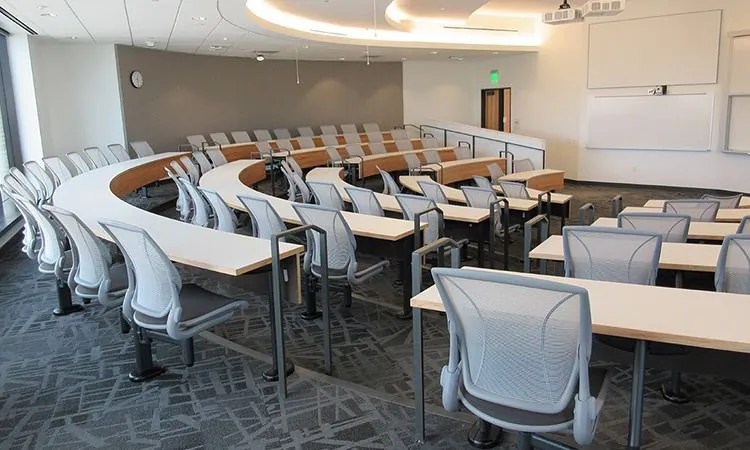
The Complete Coaching Centre Furniture List
Use this list room by room. Quantities depend on your batch size and how many batches share a room in a day.
| Area | Furniture needed | How many |
|---|---|---|
| Reception and counselling | Reception counter, visitor chairs, counsellor table, brochure rack | 1 counter; chairs for waiting parents and students |
| Classrooms and lecture halls | Student desks and chairs, or long benches; faculty table and chair | One seat per student in your largest batch |
| Test hall | Single-seat desks spaced apart | One per candidate in a test sitting |
| Self-study room or library | Study carrels or reading tables, chairs, book racks | Based on how many students stay after class |
| Faculty room | Faculty desks, chairs, staff lockers, almirah for notes | One desk and locker per teacher |
| Admin and records | Office desks, filing cabinets, steel almirahs, a safe for fees and documents | Based on records kept |
| Study material store | Steel storage racks | Based on stock of books and test papers |
| Bag and phone deposit | Multi-door steel lockers | One door per student in a batch, if bags or phones are kept outside |
If the institute is residential, add hostel rooms. Our hostel furniture list covers beds, wardrobes and study tables for each student.
Classroom Furniture: Desks, Chairs and Benches
Classrooms are where most of the money goes. Coaching students are usually older teenagers and adults, so use adult sizes, not school sizes. There are three common layouts:
- Single desk and chair: each student has a separate seat. Easy to rearrange for tests and group work.
- Two-seater desk with chairs: saves space and cost while keeping a clear surface per student.
- Long bench with attached desk: seats three or more in a row. It fits the most students into a lecture hall, but rows are harder to move.
| Item | Typical size (mm) | Typical size (feet) |
|---|---|---|
| Single student desk top | 600 × 450, 750 high | 2 × 1.5 ft, 2.5 ft high |
| Two-seater desk top | 1200 × 450, 750 high | 4 × 1.5 ft, 2.5 ft high |
| Student chair seat height | 430–450 | about 1.5 ft |
| Faculty table | 1200 × 600, 750 high | 4 × 2 ft, 2.5 ft high |
| Gap between rows | 750–900 | 2.5–3 ft |
These are typical sizes for adult learners in India. For younger students and full height charts by class, see our school desk and bench size chart.
Storage: Lockers, Almirahs and Racks
Storage is what most coaching centres under-plan. Four needs come up again and again:
- Student bags and phones. Many centres keep bags or phones outside the classroom or test hall. A bank of small multi-door steel lockers near the entrance handles this. See our steel locker size chart to pick the door size.
- Faculty belongings and notes. One locker per teacher, plus a steel almirah (alamari) for shared notes and question banks.
- Admission records and fee documents. Steel filing cabinets or almirahs with locks. For records you cannot afford to lose, a fireproof filing cabinet is fire-rated up to 120 minutes, with a certificate available.
- Study material and test papers. Open steel storage racks in a store room, labelled by course and batch.
How to Plan Furniture for a Coaching Centre
- Fix your largest batch size for each classroom. That sets the number of seats.
- Measure every room, including door widths, pillars and window positions.
- Choose a layout (single, two-seater or bench) and check that a walkway of about 750–900 mm stays clear between rows.
- Plan the test hall separately, with single desks spaced apart.
- Count storage needs: lockers for bags or phones, lockers for staff, almirahs and racks.
- Fix one size and colour per item so new branches and repeat orders match.
- Get a written quote with material, finish, guarantee and lead time confirmed.
Common Mistakes
| Mistake | What it causes | How to avoid it |
|---|---|---|
| Buying school-size desks for adult students | Cramped, uncomfortable seating | Use adult desk and chair heights |
| Packing rows too tight | Blocked exits, students climbing over seats | Keep 750–900 mm between rows |
| No place for bags or phones | Bags blocking aisles; phones in test halls | Plan a locker bank at the entrance |
| Records kept in open shelves | Lost or damaged documents | Use lockable almirahs or fireproof cabinets |
| Different furniture in each branch | Harder repeat orders and spares | Fix one standard per item |
Ordering from The Royal Safe Company
| What you need to know | Details |
|---|---|
| Company | Fourth-generation family business, manufacturing since 1934 |
| Factory | Own factory in Sonipat, Haryana, about 100 staff, in-house CNC and fabrication |
| Material and finish | Powder-coated mild steel from TATA Steel and JSW; powder coat 80–100 microns, cross-hatch tested |
| Certification | ISO 9001:2015 and Greenpro |
| Lead time | Confirmed in writing with the quotation |
| Guarantee | 2 years in India, 1 year on export |
| Minimum order | No minimum order in India; bulk orders get 10–20% discount |
| Price | Quote-based, exclusive of 18% GST; delivery extra |
See classroom desks, lockers and library shelving in our Academy Collection.
Setting up or expanding a coaching centre? Email your room sizes, batch sizes and the list of rooms to sales@royalsafeco.com for a written quote.
Frequently Asked Questions
What furniture is needed for a coaching centre?
A coaching centre needs student desks and chairs or benches for classrooms, single desks for a test hall, a reception counter and visitor chairs, faculty desks and lockers, steel almirahs or filing cabinets for records, storage racks for study material, and a locker bank for student bags or phones.
What is a good desk size for coaching classes?
For adult and older teenage students, a single desk top of about 600 × 450 mm at 750 mm high is typical, with a chair seat height of about 430–450 mm. A two-seater desk is typically about 1200 × 450 mm.
How much space should be left between rows in a coaching classroom?
Leave a clear walkway of about 750–900 mm (2.5 to 3 feet) between rows, so students can move in and out without climbing over seats. Check your local fire and building rules as well.
Do coaching centres need lockers?
Many do. Centres that keep bags or phones outside the classroom or test hall use a bank of small multi-door steel lockers near the entrance, and teachers usually get one locker each.
Do you make furniture for coaching centres and training institutes?
Yes. The Royal Safe Company makes student desks and chairs, steel lockers, almirahs, filing cabinets and storage racks for coaching centres and training institutes from our own factory in Sonipat, Haryana. There is no minimum order in India.